
Water projects firm Vishnu Prakash R Punglia, the 20th company to launch its IPO in the current year, saw its shares closing at a 47 per cent gain over its issue price on Tuesday. Such a huge one-day pop is considered rare; however, it has become the norm this year. The average listing-day gain for these 20 IPOs in 2023 is 34 per cent, and their average gain to date stands at 46 per cent.

The S&P BSE Sensex ended up 41 points at 27,787 and the Nifty50 ended up 20 points at 8,528.
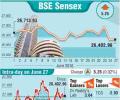

From the Sensex firms, Adani Ports, Eternal, Bajaj Finance, Axis Bank, Bajaj Finserv, Reliance Industries, Power Grid and NTPC were the major gainers. Sun Pharma, however, tanked over 5 per cent.

BSE Midcap and BSE Smallcap indices settled the day 0.7% and 0.9% higher

Mutual funds' largecap investment universe is expected to see seven changes in the upcoming stock reclassification exercise by the Association of Mutual Funds in India (Amfi). According to a report by IIFL Securities, Hero MotoCorp, Zydus Lifesciences, JSW Energy, NHPC, Bharat Heavy Electricals, Bosch and Samvardhana Motherson are expected to earn upgrades in the revised list of largecap, midcap and smallcap stocks set to be released in the first week of July. Amfi revises the list at the start of January and July every year based on the previous six-month performance of the stock.
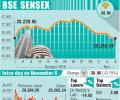
The 30-share Sensex ended down 39 points at 26,265.
BSE Midcap and BSE Smallcap indices registered an uptick of 0.06%, and 0.05%, respectively

The S&P BSE Sensex ended up 134 points at 27,279 and the Nifty50 ended up 42 points at 8,371.
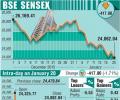
The S&P BSE Sensex ended down 418 points at 24,062.
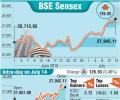
The S&P BSE Sensex rose 127 points to end at 27,942.
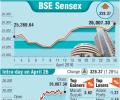
The S&P BSE Sensex ended up 328 points at 26,007 and the Nifty50 ended up 108 points at 7,963.

From the Sensex pack, Infosys tanked over 8 per cent after the company reported a lower-than-expected 11 per cent rise in net profit for the June quarter and delivered a shocker as it slashed its FY24 growth outlook to 1-3.5 per cent on delayed decision-making by clients amid global macro uncertainties. Hindustan Unilever, HCL Technologies, Wipro, and Tech Mahindra were the other major laggards. On the other hand, Larsen & Toubro rose the most by 3.88 per cent after it bagged an order of worth over Rs 7,000 crore from the bullet train project.
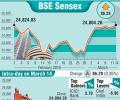
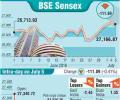
The S&P BSE Sensex ended up 364 points at 28,078 and the Nifty settled 132 points higher at 8,683.


The 30-share Sensex ended down 181 points at 26,657.

The sharp rally in the broader markets has propelled India's market capitalisation (m-cap) to a new high. The combined m-cap of all BSE-listed firms rose to Rs 291.9 trillion in intraday trade on Thursday before settling lower at Rs 290.9 trillion. The previous record was on December 14, 2022, at Rs 291.3 trillion.
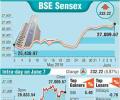
The S&P BSE Sensex ended up 232 points to settle above 27,000 at 27,010 for the first time since October 28, 2015.
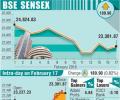
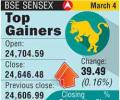
The S&P BSE Sensex ended up by 39 points at 24,646.

A key reason for the rise in crypto currencies in 2023 is the possibility of the world's first Bitcoin ETF over the next few months.


From the Sensex pack, IndusInd Bank, NTPC, Asian Paints, Hindustan Unilever, JSW Steel, Tech Mahindra, Bajaj Finance, Infosys, Wipro, ICICI Bank, Bajaj Finserv, HDFC Bank and Tata Motors were among the major laggards. HCL Technologies, Power Grid, Titan, Reliance Industries, UltraTech Cement, Tata Steel, State Bank of India and Mahindra & Mahindra were the gainers.
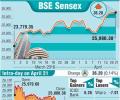

BSE Smallcap index outperformed the frontline indices to rise 0.6%, while the BSE Midcap was flat

Equity investors became richer by over Rs 5.77 lakh crore on Tuesday, helped by a rally in the broader market where the BSE benchmark jumped nearly 2 per cent. The BSE Sensex zoomed 934.23 points or 1.81 per cent to settle at 52,532.07. Driven by the rally in equities, the market capitalisation of BSE-listed firms jumped by Rs 5,77,006.83 crore to stand at Rs 2,40,63,930.50 crore. "Absence of fresh selling triggers in the domestic and global economy along with falling commodity prices relieved the heavily discounted equity market to showcase recovery.

The S&P BSE Sensex ended down 205 points at 27,710 and the Nifty settled 56 points lower at 8,510.

At first glance, the numbers show a mixed trend.
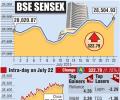

The S&P BSE Small-cap index has recovered 26 per cent as compared to a 23 per cent rise in the S&P BSE Sensex.
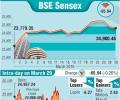
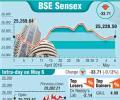
The S&P BSE Sensex ended at 24,900, down by 66 points.
From the 30-share Sensex blue-chip pack, Titan, Adani Ports, UltraTech Cement, Tata Consultancy Services, NTPC, Bharti Airtel, Tech Mahindra, Infosys, Hindustan Unilever and JSW Steel were the biggest laggards.

The S&P BSE Sensex gained 7 points to end at 28,815 and Nifty50 dipped 2 points to close at 8,520.

From the 30 Sensex firms, Larsen & Toubro, Reliance Industries, Axis Bank, Asian Paints, Tata Motors, Bajaj Finance, Maruti, Bajaj Finserv, Kotak Mahindra Bank, Titan, Adani Ports and HDFC Bank were the major laggards. JSW Steel emerged as the only gainer.
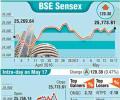
The S&P BSE Sensex gained 120 points to close at 25,774.

The S&P BSE Sensex ended down 157 points at 28,052 and the Nifty50 slipped 28 points to settle at 8,639.
Zomato emerged as the biggest gainer, followed by Reliance, Nestle, Asian Paints and Power Grid.
Seven consecutive sessions of decline in the equity market has eroded the wealth of investors by a whopping Rs 10.42 lakh crore and the benchmark Sensex has tumbled more than 2,000 points during this period. Concerns over more rate hikes by developed economies, weak global equity markets and fresh foreign fund outflows from the domestic market have dented investor sentiments. On Monday, the BSE Sensex dropped 175.58 points or 0.30 per cent to end at 59,288.35 points, marking a decline for seven straight trading sessions.
